

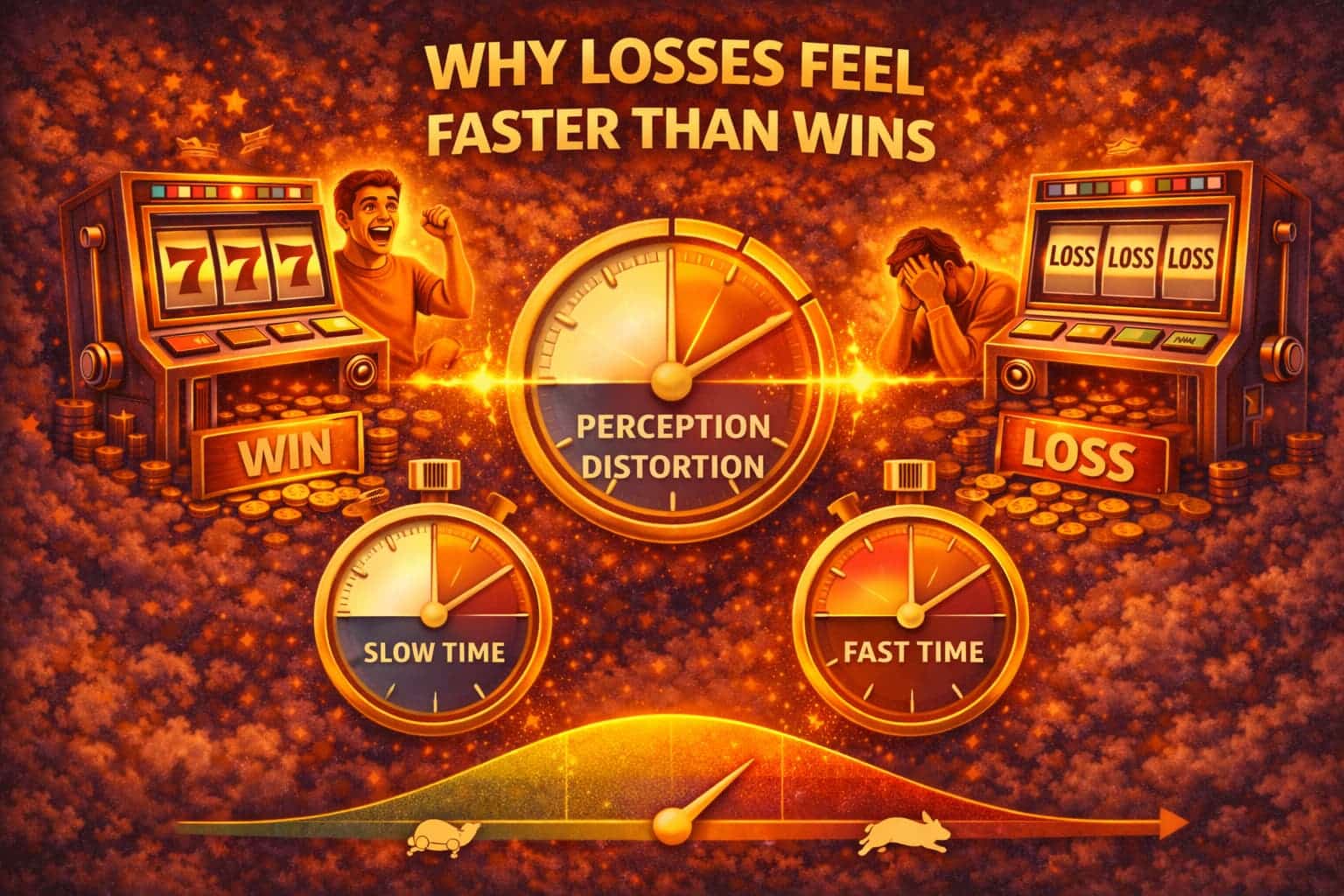
If you’ve ever felt like your balance drains in minutes but takes hours to build back up, you’re not imagining it. Losses really do feel faster than wins — and that feeling is rooted far more in psychology than in mathematics. Whether you’re playing table games, sports betting, or online pokies, the emotional experience of losing money is processed very differently from the experience of winning it.
This imbalance shapes how players remember sessions, evaluate outcomes, and decide whether to keep playing. A short streak of losses can feel abrupt and shocking, while a similar-sized win often feels slow, underwhelming, or even forgettable. These reactions influence betting behaviour, risk tolerance, and session length, often pushing players into decisions they wouldn’t make in a neutral emotional state.
Understanding why losses feel faster isn’t about avoiding gambling altogether — it’s about recognising how the mind interprets money movement, volatility, and time. By breaking down the psychological mechanics behind loss perception, players can regain a sense of control, set better limits, and make decisions based on awareness rather than emotion.
Loss Aversion Explained
Loss aversion is one of the most powerful and well-documented principles in behavioural psychology. It describes the tendency for people to feel the pain of losing something more intensely than the pleasure of gaining the same thing. In simple terms, losing $50 hurts more than winning $50 feels good.
This asymmetry is deeply wired into human decision-making. From an evolutionary perspective, losses historically carried more risk than gains — losing resources could threaten survival, while gains were beneficial but not essential. That instinct still influences how modern brains respond to financial outcomes.
In gambling contexts, loss aversion means that each losing bet registers as a stronger emotional event than a winning bet of equal size. Over the course of a session, this creates the impression that losses are accumulating rapidly, even if wins and losses are mathematically balanced for long stretches.
Importantly, loss aversion doesn’t require large losses to activate. Small, repeated losses — common in online pokies or high-frequency betting — compound emotionally. Each one reinforces the sensation that money is disappearing faster than it should, even when the overall pace of play hasn’t changed.
This psychological weighting skews perception. Players don’t experience their balance as a neutral number changing over time; they experience it as a series of emotional hits and reliefs, with the hits landing harder and lingering longer.
Emotional Weighting
Not all monetary outcomes are emotionally equal. Emotional weighting refers to the way the brain assigns different levels of importance to wins and losses, independent of their actual value. Losses are given disproportionate emotional weight, while wins are often discounted or quickly absorbed.
When you lose a bet, especially unexpectedly, it triggers a stress response. This may include frustration, disappointment, irritation, or anxiety. These emotions are vivid and attention-grabbing, causing the moment to feel sharp and significant. In contrast, wins often generate brief excitement followed by rapid normalisation.
This difference affects memory. Players tend to remember losses more clearly and for longer periods than wins. A session with multiple small wins and a few notable losses is often remembered as a losing session, even if the net result is close to break-even.
Emotional weighting also compresses time perception. A losing streak can feel fast because each loss stands out, creating the sense of rapid progression. Wins blur together more easily, making them feel slower or less impactful by comparison.
This is especially pronounced in fast-paced games. In slots, for example, spins resolve in seconds. A run of non-winning spins feels like money vanishing instantly, while wins may not offset the emotional impact unless they’re large enough to break through that weighting bias.
Stake Escalation Behaviour
When losses feel fast, players often respond by changing how they bet. One of the most common reactions is stake escalation: increasing bet size in an attempt to “catch up” or reverse the perceived speed of losses.
This behaviour isn’t always conscious. The brain interprets the falling balance as a problem that needs correcting, and increasing stakes feels like a way to slow or undo that decline. Ironically, this often accelerates losses rather than slowing them.
Stake escalation amplifies emotional volatility. Each larger bet carries more emotional weight, making losses feel even sharper and wins feel disproportionately relieving. This creates a feedback loop: heightened emotion leads to bigger bets, which lead to stronger emotional reactions.
Importantly, stake escalation changes perception more than it changes outcomes. The math doesn’t improve, but the emotional swings become more intense, reinforcing the idea that losses are happening faster and more dramatically than before.
In games with rapid resolution, including online pokies, crash games, and fast table variants, this escalation can unfold quickly. What begins as a modest attempt to “recover” can spiral into high-risk play within minutes, driven entirely by emotional pacing rather than strategy.
Stake Escalation in Action: How Losses Accelerate
To see how stake escalation leads to deeper losses, consider a common slots scenario. A player begins with $1 spins and experiences a series of small losses. The balance declines steadily but quietly, barely noticeable spin to spin. Eventually, the player checks their balance and feels a sharp sense of discomfort, the money seems to have vanished faster than expected.
In response, the player increases the stake to $2 or $3 per spin, believing this will help “recover” more quickly. At first, this feels rational: one good win could undo several losses at once. But the game’s odds haven’t changed. The higher stake simply means each losing spin now removes more money, accelerating the balance drop.
As the balance falls faster, emotional pressure increases. The player may escalate again to $5 or $10 spins, not because of a plan, but because the situation feels urgent. Each spin now carries significant emotional weight. Losses sting more, wins feel desperately relieving, and decision-making becomes reactive rather than deliberate.
What started as low-risk entertainment has shifted into high-volatility play driven by emotional pacing. The faster the losses feel, the more the player tries to correct them and the faster the balance declines. Stake escalation doesn’t counter loss momentum; it magnifies it, turning perceived speed into real financial acceleration.
Win Normalisation
One of the reasons losses feel faster than wins is that wins are quickly normalised. Once a win is added to the balance, it often stops feeling like “money gained” and starts feeling like “money owned.” From that point on, any subsequent loss is perceived as losing your money, not giving back a previous win.
This psychological shift happens almost instantly. A $100 win feels exciting when it occurs, but moments later it becomes part of the baseline. Losing $50 afterward doesn’t feel like losing half of the win — it feels like losing $50 of your own funds.
Win normalisation makes gains fragile and losses heavy. Wins don’t accumulate emotionally in the same way losses do, because they’re absorbed into expectations rather than celebrated repeatedly.
This is why players often say things like, “I was up earlier, but now I’m down”, even if the final loss is small. The earlier win has been mentally banked, and losing it feels like a setback rather than a return to equilibrium.
In online pokies, where wins may come as frequent small hits, this effect is magnified. Each win feels fleeting, while each loss feels permanent, reinforcing the sensation that losses are happening faster than wins ever did.
Why Balance Drops Feel Sudden
Even when losses occur gradually, balance drops often feel abrupt. This is because players tend to monitor their balance emotionally rather than continuously. Attention spikes when something goes wrong, not when things are stable.
During periods of small wins or minor losses, players may not actively track their balance. When a noticeable drop occurs — often after a losing streak or a higher-stake loss — it feels sudden, as if the money vanished all at once.
This perception is reinforced by interface design. Many platforms display balances prominently but don’t show detailed context for how changes occurred. Without a clear sense of progression, the brain fills in the gap with emotional interpretation.
Balance drops also trigger loss aversion more strongly than balance increases trigger pleasure. Seeing a lower number than expected creates a jolt of discomfort, making the change feel larger and faster than it actually was.
On online pokies, where hundreds of spins can occur in a short time, this effect is common. A player may feel like they were “fine a moment ago,” even if the balance has been slowly declining for the entire session.
Psychological Pacing
Psychological pacing refers to how quickly the mind feels events are unfolding, independent of real time. Losses compress psychological time, making sessions feel shorter and more intense. Wins expand it, making time feel slower and more relaxed.
This mismatch affects decision-making. When losses feel fast, players feel urgency. Urgency reduces patience, increases impulsivity, and narrows focus. Players become more reactive and less strategic.
Wins, by contrast, create a sense of comfort. Comfort slows perceived time and reduces the pressure to act. This is why players often play longer during winning sessions, time feels abundant and unthreatening.
The problem arises when these two pacing modes collide. A session that begins calmly can suddenly feel frantic after a few losses, even if the stakes and speed haven’t changed.
Fast-paced games like online pokies are particularly effective at shifting psychological pacing. Rapid losses can make minutes feel like seconds, pushing players toward rushed decisions that reinforce the sensation of money disappearing too quickly.
Slot Design Factors
Game design plays a significant role in how losses are perceived. Online pokies are engineered to sustain engagement through rapid feedback, near-misses, sound effects, and frequent but small wins. While these elements increase entertainment value, they also shape emotional perception in subtle but powerful ways.
One of the most important contrasts lies in how wins are amplified while losses are muted. Winning spins are deliberately highlighted with extended animations, celebratory music, and flashing symbols. These features stretch the emotional moment of a win, making it feel larger and more memorable than its actual monetary impact.
Losses, by comparison, are intentionally quiet. Many losing spins pass with minimal feedback, and even partial returns that are technically losses may still trigger positive sounds or visuals. This softens the emotional impact in the moment, allowing losses to accumulate without drawing attention.
Because of this imbalance, players often fail to emotionally register individual losses as they occur. Awareness arrives later, when the balance is checked and the cumulative decline becomes obvious, creating the sensation that money disappeared suddenly.
Near-misses further intensify this effect by keeping attention focused on potential wins rather than actual outcomes. Together, these design choices don’t change the odds, but they strongly influence perception, making losses feel faster, heavier, and more abrupt than wins ever did.
Managing Emotional Response
Gambling is meant to be emotional. The tension, excitement, and anticipation are part of the appeal. Problems start when those emotions quietly take over decision-making and make losses feel urgent, personal, or out of control. Managing your emotional response is about recognising when perception shifts and giving yourself ways to slow things down before momentum builds.
One of the most effective ways to stay in control is using responsible gambling tools before emotions are involved. Deposit limits place a hard cap on how much money can be added within a set period, which helps prevent impulsive top-ups when a balance drop feels sudden. Loss limits define how much you are prepared to lose in advance and stop play automatically once that point is reached, removing the need to make a rational decision in an emotional moment.
Session-based limits are just as important. Deciding how long you will play, rather than trying to finish on a win, reduces emotional pacing and cuts off the urge to chase. Time-outs provide short cooling-off periods that interrupt fast play without requiring a long-term commitment, while self-exclusion offers a stronger reset when gambling starts to feel compulsive rather than entertaining.
Paying attention to behaviour is often more useful than watching the balance. Increasing stake sizes, speeding up play, feeling frustrated, or thinking about recovery instead of enjoyment are all signs that emotional bias is creeping in. Recognising these changes early gives you a chance to pause before losses accelerate.
It is also important to know when to involve support beyond the platform itself. Speaking to trusted friends, family, or professional support services can provide perspective when gambling stops feeling fun. Using outside help is not a sign of weakness. It is a practical step in a system designed to amplify emotion.
Finally, reframing gambling as entertainment rather than income can dramatically change how losses feel. Money set aside for gambling should be viewed as the cost of being entertained, no different from paying for a cinema ticket, a concert, or a night out. When that money is treated as spent the moment play begins, rather than something that needs to be protected or recovered, losses lose much of their emotional sting and the experience stays in its proper place.
Conclusion: Everyone Needs to Manage the Emotional Pace of Gambling Sessions
Losses feel faster than wins because the human brain is built to prioritise pain over pleasure, urgency over comfort, and threats over rewards. In gambling environments, this natural bias is intensified by rapid gameplay, emotional weighting, and design elements that blur the perception of gradual loss.
Wins are quickly absorbed and normalised, while losses stand out, linger, and demand attention. This creates the powerful illusion that money disappears faster than it arrives, even when outcomes unfold exactly as probability predicts.
By understanding loss aversion, emotional pacing, and the psychological mechanics behind balance perception, players can step back from reactive decision-making. Awareness doesn’t change the math, but it does change how that math is experienced.. Losses may always feel faster — but they don’t have to control the session.
Frequently Asked Questions
Why do losses feel more intense than wins, even when the amounts are the same?
Losses feel more intense because of loss aversion, a core psychological bias where the brain treats losses as more significant than gains. When money is lost, it triggers stress-related emotional responses such as frustration, anxiety, or disappointment. These emotions are processed more deeply and remembered more vividly than the short-lived excitement of winning.
Do fast-paced games like online pokies exaggerate the feeling of losing quickly?
Yes, fast-paced games — especially online pokies — significantly exaggerate the feeling that losses happen quickly. Spins resolve in seconds, allowing many losing outcomes to occur back-to-back with little time for emotional processing. Individually, these losses feel minor, but their impact accumulates beneath the surface.
Wins, however, are treated very differently. When a win occurs, the game slows the moment down with bright animations, celebratory sounds, coin showers, and countdowns, deliberately drawing attention to the result. This sensory reinforcement makes wins feel larger, more meaningful, and far more memorable than their actual monetary value.
Losing spins receive none of this emphasis. They pass quietly and almost invisibly, delaying emotional awareness until the balance is checked. The result is a distorted perception: wins feel vivid and significant, while losses feel like they “suddenly” appeared, even though they happened gradually.
Why does my balance seem to drop suddenly, even if I didn’t notice steady losses?
This happens because players don’t usually monitor their balance continuously, they react to noticeable changes. Small losses often go emotionally unnoticed, especially during engaging gameplay. When the balance finally crosses a mental threshold, attention snaps back to the number, creating the illusion that the drop happened all at once.
Why do wins stop feeling satisfying so quickly during a session?
Wins lose their emotional impact because of win normalisation. Once a win is added to your balance, it becomes part of your perceived baseline almost immediately. The brain adjusts expectations upward, treating the new balance as “normal” rather than a gain.
Does feeling like losses are speeding up lead to worse decisions?
Very often, yes. When losses feel fast, the brain shifts into urgency mode. This reduces patience and increases impulsive behaviour, such as raising stakes, speeding up play, or abandoning planned limits.
Can understanding this psychology actually help me gamble more responsibly?
Absolutely. While it doesn’t change the odds, understanding why losses feel faster gives you emotional distance from the experience. When you expect losses to feel heavier than wins feel good, they become less shocking and less likely to trigger reactive behaviour.
This awareness supports better habits, such as sticking to time limits, avoiding stake escalation, and taking breaks before emotions take over. Gambling becomes a conscious activity rather than an emotionally driven one.
Is this feeling a sign that a game or casino is unfair?
Not necessarily. The sensation of losses happening faster is a psychological response, not proof of unfairness. Even perfectly fair, well-regulated games produce this effect because the bias exists in the player, not the software.
What’s the most effective way to counteract the emotional impact of losses?
The most effective approach is pre-commitment. Set clear limits on time, spend, and stake size before you start playing. This removes decision-making from emotionally charged moments.
Taking regular breaks, slowing the pace of play, and paying attention to behavioural changes — like betting faster or feeling rushed — are also powerful tools. Emotional awareness is often more useful than watching the balance itself.