

When it comes to online gambling, few features capture the imagination quite like progressive jackpots. The idea of a jackpot growing to life-changing sums, sometimes reaching millions, can be incredibly enticing. But behind the thrilling prospect of hitting the big prize lies a complex system that determines how these jackpots accumulate, when and why they reset, and what really affects your chances of winning. Understanding how progressive jackpots work—not just the flashy totals but the mechanics beneath—can help players appreciate the fairness and design of these games and avoid common misconceptions that surround them.
In this article, we’ll dive deep into the mechanics of progressive jackpots, breaking down how contributions add up, explaining the concept of networked jackpots, clarifying why timing doesn’t influence outcomes, and more. We’ll also look at why jackpots reset and bust some myths around “ready to hit” jackpots. By the end, you’ll have a solid grasp of how these thrilling jackpots grow and why they operate the way they do.
Contribution Mechanics
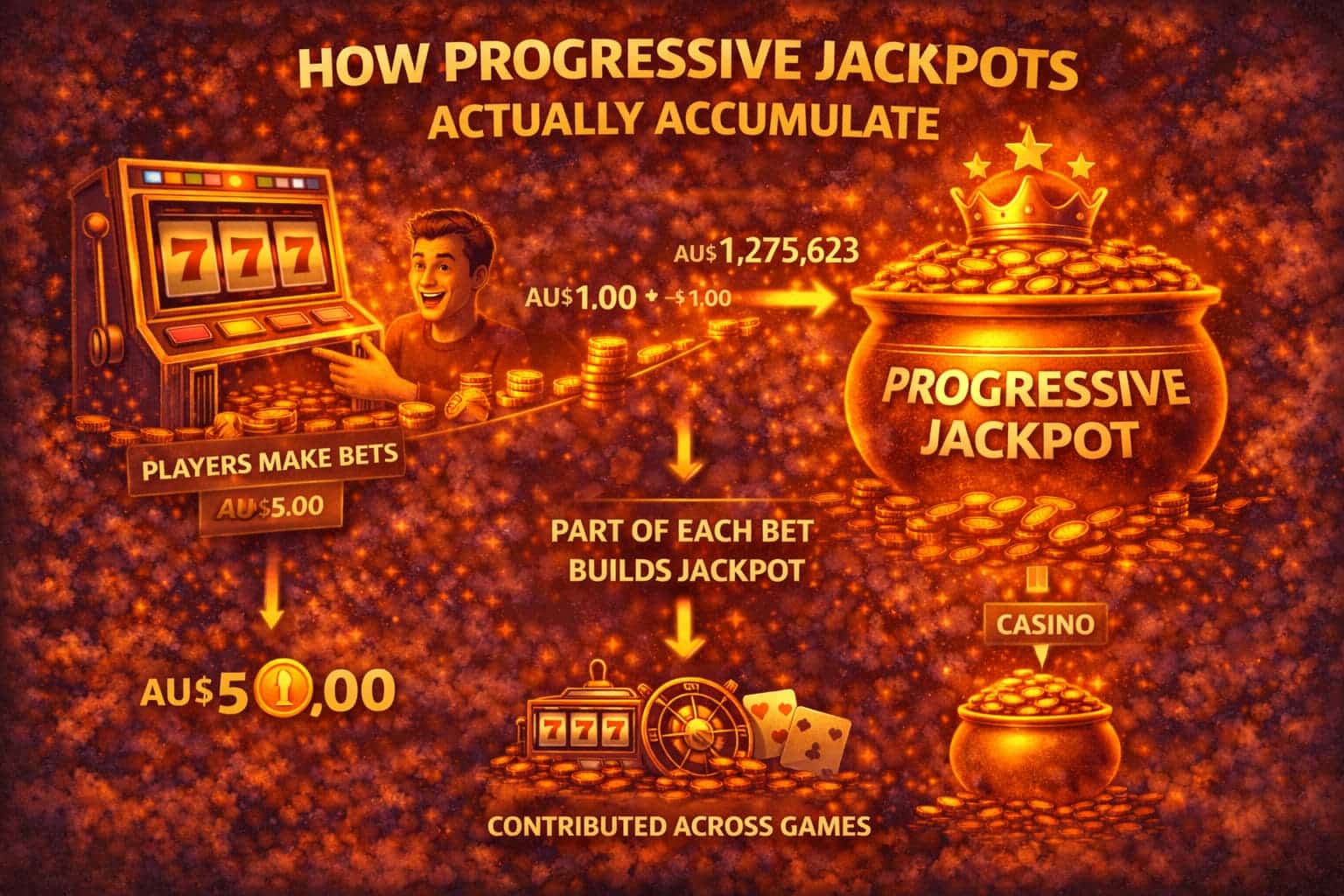
At the core of every progressive jackpot is a simple but powerful idea: a small portion of every bet placed on the game contributes to the jackpot pool. This “contribution” is usually a tiny percentage of each wager, often ranging between 1% and 5%, depending on the game and provider. Every time a player spins the reels or places a bet on a progressive game, part of their stake adds to the jackpot, causing it to climb steadily.
For example, imagine you’re playing an online pokie with a 3% contribution rate and you bet $1 per spin. That means $0.03 from your spin is instantly added to the jackpot pool. If hundreds or thousands of players are spinning this game simultaneously, those tiny increments quickly accumulate into a massive prize.
It’s important to note that the contribution rate varies from game to game and also depends on the provider’s payout model. Some progressives have higher contribution rates but smaller base jackpots, while others start bigger but grow slower. This delicate balance ensures jackpots grow over time without eating excessively into regular payouts.
When Jackpots Increment
You might wonder whether the jackpot number jumps up only when a new contribution is added or if it increases constantly. In reality, jackpots often increment in real-time, reflecting contributions as they come in but sometimes with a smoothing effect for visual appeal.
Many jackpots are displayed as smoothly increasing numbers, not discrete jumps, to create excitement and the sense of momentum. The visible jackpot is often “animated” by software that simulates a continuous climb, even though actual increments are tied to specific bets. This visual feedback encourages players to stay engaged and believe the jackpot is always growing, which it is, but the underlying math is tied to precise contributions.
Some jackpots update every few seconds or fractions of a second, depending on network load and game design. In multi-casino networks, these updates are coordinated across servers to maintain a consistent jackpot value for all players seeing the game at once.
Networked Jackpots Explained
One of the most fascinating aspects of progressive jackpots is the concept of networked jackpots, also called pooled or shared jackpots. Unlike standalone jackpots tied to a single game instance or casino, networked jackpots combine contributions from multiple games or multiple casinos into one giant prize pool.
For example, Microgaming’s Mega Moolah is famous for its multi-million-dollar networked jackpot. When players spin Mega Moolah at any casino offering the game, their bets contribute to the same jackpot pool. This allows the jackpot to grow much faster than if it was limited to just one casino or player base.
Networked jackpots can be linked across dozens or even hundreds of casinos worldwide, allowing massive jackpots to accumulate rapidly and gain worldwide attention when they hit. The jackpot on these games often climbs visibly on every platform hosting them, creating a thrilling sense of shared anticipation.
Some providers take networked jackpots further by linking multiple games with similar themes or from the same developer, creating jackpot networks across different titles that funnel contributions to the same prize. This approach maximizes player engagement and jackpot size simultaneously.
Probability vs Jackpot Size
One of the most persistent myths around progressive jackpots is the idea that a bigger jackpot means you’re “due” or that your chances improve as the jackpot grows. This is simply not true.
The probability of winning a progressive jackpot is fixed and programmed into the game’s RNG (Random Number Generator) algorithm. Whether the jackpot is $100,000 or $10 million, the odds of hitting it remain constant per bet or spin.
What changes is the potential reward, not the likelihood. The jackpot size grows to attract more players, but the game’s fairness and odds stay the same. Each spin or bet has an independent chance of winning the jackpot, unaffected by how large or small the current jackpot total is.
For instance, if the odds of hitting the Mega Moolah jackpot are 1 in 50 million per spin, those odds don’t improve just because the jackpot has grown. It might feel like the big prize is “ready to hit,” but mathematically, every bet is equally unlikely to be the winner regardless of the current jackpot amount.
Why Jackpots Reset
When a progressive jackpot is won, the prize pool doesn’t simply disappear; it resets to a predetermined base amount, which varies from game to game. This base amount is the “starting point” for the next jackpot cycle.
For example, Mega Moolah resets to around $100,000 after a jackpot hit. Other games might reset at a few thousand dollars or even tens of thousands, depending on the provider’s setup.
The reset occurs immediately after the jackpot is awarded, and the contribution cycle starts anew. Players then contribute to growing the jackpot once again, beginning the climb back to those life-changing sums.
Why reset? Because progressive jackpots rely on the cycle of growth to sustain themselves. The base amount provides a guaranteed minimum prize, while the contributions ensure the jackpot can grow into enormous amounts over time.
Misconceptions About “Ready to Hit”
The idea of a jackpot being “ready to hit” or “due” is a common gambler’s fallacy. Many players believe that if a jackpot has been around for a long time, or if the total is very high, it must be close to paying out. However, progressive jackpots don’t operate on a predictable timeline.
Jackpots are not like meters filling up to a point where they trigger a win. Instead, the winning spin or bet is random, with a fixed probability on every wager, independent of previous results. The misconception often leads to “chasing the jackpot”—players continuing to bet more or longer, believing they’re increasing their chances, when in fact, the odds remain the same.
How Wins Are Triggered
Jackpot wins in progressive games are usually triggered through one of two primary mechanisms, depending on the game’s design and the provider’s approach:
Random Trigger
In some progressive jackpots, the trigger is purely random and independent of the game’s main outcomes. This means that every bet placed on the game, regardless of whether it results in a win or loss, carries a tiny, fixed chance of hitting the jackpot. The game’s RNG (Random Number Generator) system selects winning bets at random according to programmed odds.
For instance, a player might spin a slot and lose, but still trigger the jackpot by chance alone. This randomness keeps the jackpot fair and unpredictable, ensuring that every spin has an equal opportunity, independent of game results.
Symbol or Event Trigger
Many progressive jackpots are tied to specific in-game events or symbol combinations. These jackpots don’t trigger randomly on any bet but require players to achieve a particular condition in the game to unlock the jackpot opportunity.
A common example is landing a rare jackpot symbol combination on the reels. For example, some online pokies require three special jackpot symbols to appear simultaneously on an active payline. Only when this rare combination occurs does the jackpot bonus round or spin get activated, giving players the chance to win the progressive prize.
Another popular approach is the jackpot bonus round. Players must trigger this bonus by hitting scatter symbols or completing a mini-game within the slot. Once inside this bonus round, players may spin a jackpot wheel or select from hidden prizes, with the chance to win one of several jackpot tiers. This mechanic combines skill or chance elements with the jackpot feature, adding layers of excitement and engagement.
Example: Mega Fortune
Consider NetEnt’s famous Mega Fortune slot, which uses an event-triggered jackpot system. Players must land three bonus wheel scatter symbols to enter the jackpot bonus round. In this round, they spin a prize wheel that can award one of three progressive jackpots (Rapid, Major, or Mega). Only when the bonus round is reached and the wheel lands on a jackpot segment is the progressive prize won.
This event-based triggering method ties the jackpot directly to gameplay achievements, making it feel more interactive and rewarding beyond pure chance.
Why Timing Doesn’t Matter
Because jackpot triggers are random and independent, the timing of your bets doesn’t affect your chances. Whether you play early in the jackpot cycle when the prize is small or near the top when the jackpot is huge, your odds of winning on any individual bet are the same.
Some players try to time their play based on the jackpot size or how long it’s been since the last win, but this is a fallacy. The randomness programmed into the game means that every spin or bet has the same probability, no matter the jackpot value or elapsed time. This design protects players from false beliefs about “hot streaks” or “cold streaks” related to jackpot payouts and ensures fairness for everyone playing.
Jackpots Demystified: The Real Deal Behind Those Life-Changing Prizes
Progressive jackpots are a thrilling feature of online gambling, offering players the chance at life-changing wins that grow over time. Behind the excitement lies a carefully balanced system based on small contributions from every bet, real-time incremental increases, and random triggers that determine when the jackpot pays out.
Networked jackpots combine multiple games and casinos to build massive prize pools, while fixed probabilities keep chances fair regardless of how large the jackpot becomes. When a jackpot is won, it resets to a base amount and starts climbing again, maintaining a cycle of growth and payout.
Understanding the true mechanics of progressive jackpots dispels common myths like the idea of “ready to hit” jackpots or improved odds with bigger prizes. It also highlights the fairness built into these games, reinforcing that while jackpots offer massive rewards, they do so on a foundation of random chance and balanced design.
By grasping how jackpots accumulate and function, players can enjoy the excitement of chasing a big win with a clear, realistic view of the game — making for a more enjoyable and informed gambling experience.
FAQ’s
How does my bet contribute to the progressive jackpot?
Every time you place a bet on a progressive jackpot game, a small percentage of that wager is added to the jackpot pool. This means the more players bet, the faster the jackpot grows. The exact contribution percentage varies by game and provider, and it’s often disclosed in the game’s paytable or rules.
Are progressive jackpots shared across multiple casinos?
Many progressive jackpots are networked, meaning they link games across multiple online casinos operated by the same provider or group. This pooling of bets from many players accelerates jackpot growth and creates the potential for much larger prizes compared to standalone jackpots found at a single casino.
Does the jackpot have to reach a certain size before it can be won?
No. Progressive jackpots can be won at any time regardless of their size. The jackpot amount displayed is the current total, but the chance of winning is not directly tied to how large the jackpot is. The idea that a jackpot is “due” or “ready to hit” is a common misconception—jackpot wins are entirely random or event-driven based on the game’s programming.
What happens when a jackpot is won?
When a jackpot is won, the total prize is paid out to the lucky player, and the jackpot resets to a predetermined base amount. From there, it begins to grow again as new bets contribute to the pool. This cycle repeats continuously, with the jackpot building and paying out over time.
Can I increase my chances of winning the progressive jackpot by betting more?
In many progressive jackpot games, higher bets can increase the chance of triggering the jackpot, especially in event-triggered jackpots that require max bets or higher stakes to qualify. However, this is not universal—some jackpots have equal odds regardless of bet size. Always check the game rules to understand how bet size affects jackpot eligibility.